A two-seat urban eVTOL with the proportions of a wedge sports car — built to make the rooftop hop a recognisable category, not a press release.
The brief was small but uncompromising: make people want the rooftop hop. Most eVTOL renders look like elongated drones with a windscreen glued on. The Speedster brief asked us to start from the opposite end — what would a personal aircraft look like if it descended from the wedge-era exotics of the 70s and 80s, not from utility helicopters?
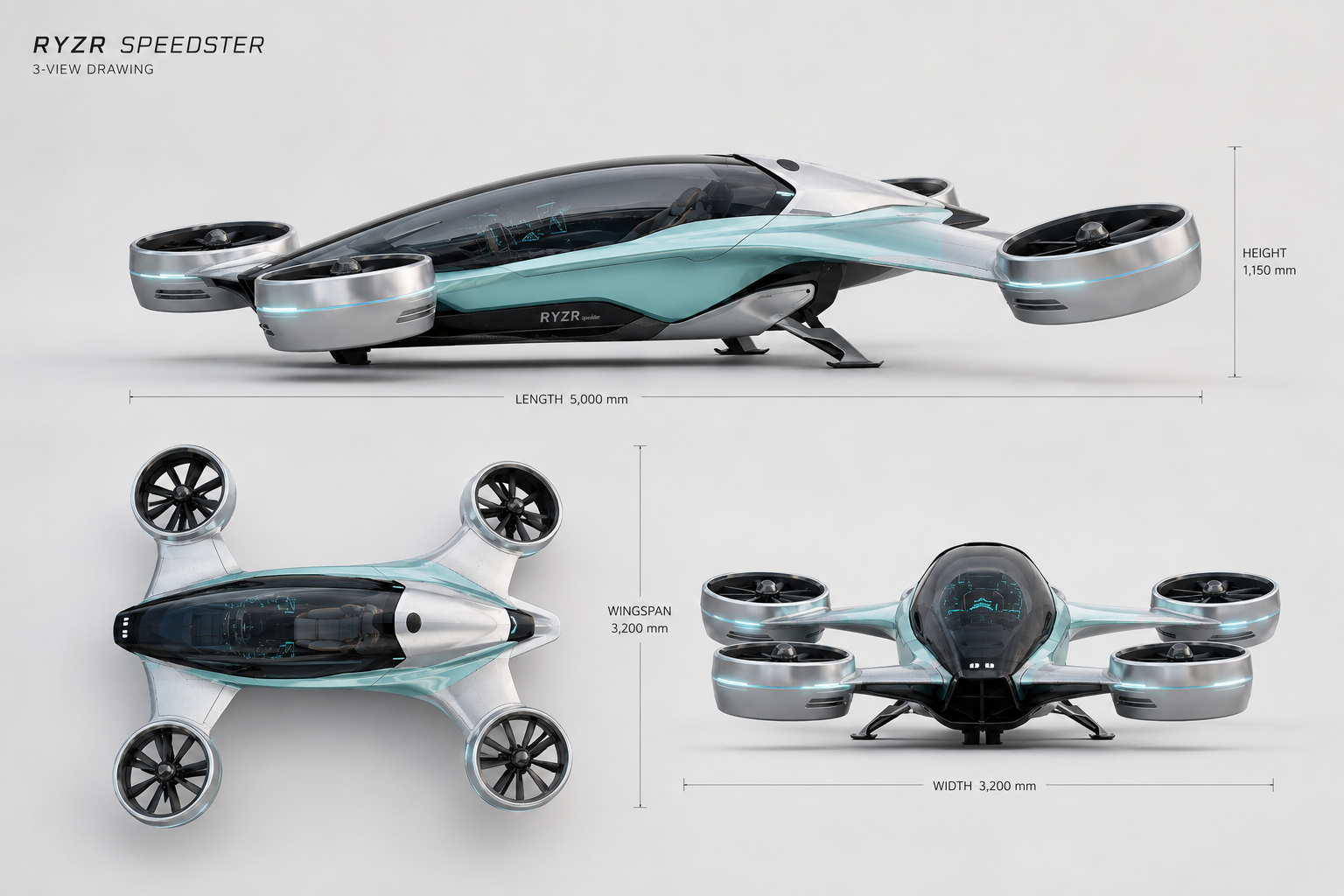
Our answer is a five-metre, two-seat halo concept built around a single graphic move: a long, low canopy that flows uninterrupted from nose to tail. Four ducted rotors mount on stalks that read as suspension arms, not engine nacelles. A teal accent — picked to survive sunset, overcast, and studio whites equally — anchors the brand from livery to dashboard glow.
The deliverables were sized for one specific moment: the seed round. Four hero renders, one 3-view, one minute of motion, and a brochure that fits in a jacket pocket — enough material to put RYZR on a stage, on a screen, and in a memorable photograph without the team having to commission anything else for six months.
The design was driven by three commitments held through every weekly review. Every detail on the airframe traces back to one of them.
Rotors below the eyeline. Skids tucked. The car-like ground stance was the line we refused to cross — the moment the rotors dominate the silhouette, the romance is gone.
From the nose tip to the tail boom, the glass is one shape. No A-pillar, no shut-line breaking the curve. It’s the move that makes RYZR photograph well from any of the four canonical angles.
Teal-cyan on the duct rings, the dashboard HUD, the underglow strip, and the wordmark. A single chromatic identity the eye can pattern-match across renders, motion, and printed materials.
The Speedster isn't an aircraft pretending to be a car. It's a piece of industrial design that happens to leave the ground. Most renders we get back ignore the rooftop. This one ate the rooftop for breakfast.
Four phases, four deliverables, one team. Reviews every Friday, no exceptions — the rhythm that kept the studio and the founder pulling in the same direction.
Workshops on audience, reference set, no-fly visual territory. Output: a one-page design brief everyone signed.
Six silhouette options to two, two to one. Final surface model locked at week six with full canopy geometry.
Four hero stills lit in three environments. 60-second film cut from a single camera move. Technical drawing in parallel.
Pocket brochure printed, logo and type system signed off, full asset library zipped and delivered with a usage rights matrix.